Regulatory Variations Across Jurisdictions Affecting Digital Blackjack Bonus Offers
Katja Koch · Aug 4, 2026

Regulatory Variations Across Jurisdictions Affecting Digital Blackjack Bonus Offers
Digital blackjack sessions operate under layers of licensing rules that differ sharply by region, and these distinctions directly determine which bonus structures players can access. Licensing bodies in North America, Europe, and the Asia-Pacific region each impose unique conditions on promotions tied to virtual table games, creating a patchwork where eligibility hinges on the operator's base jurisdiction rather than player location alone.
North American State-Level Controls
Within the United States, individual state gaming commissions set distinct parameters for bonus availability. New Jersey's Division of Gaming Enforcement requires operators to file every promotional mechanic for blackjack variants before deployment, while Pennsylvania's Gaming Control Board mandates that bonus funds carry separate wagering requirements when applied to digital sessions. Data compiled through August 2026 shows that states permitting online play maintain tighter caps on match percentages for blackjack compared with slot-focused offers, because regulators classify table games as higher-risk activities requiring additional consumer safeguards.
Canadian provincial frameworks add another dimension. Ontario's Alcohol and Gaming Commission of Ontario permits cross-border operators to extend deposit-match bonuses to blackjack tables only after completing a 30-day compliance review, whereas British Columbia's gaming authority ties bonus release schedules to real-time transaction reporting systems. These procedural differences mean players in adjacent provinces encounter unequal access windows even when the same software provider powers the platform.
European Licensing Directives
Across the European Union, the 2014 Payment Services Directive and subsequent national implementations shape bonus mechanics through consumer protection clauses. Malta's Gaming Authority, for instance, enforces a 35-times wagering threshold on blackjack bonuses that must be completed within 30 days, while Sweden's Spelinspektionen requires operators to separate bonus balances from cash balances in real time. Observers note that these rules reduce the number of active blackjack promotions available to residents in stricter jurisdictions, because operators calculate compliance costs before launching campaigns.
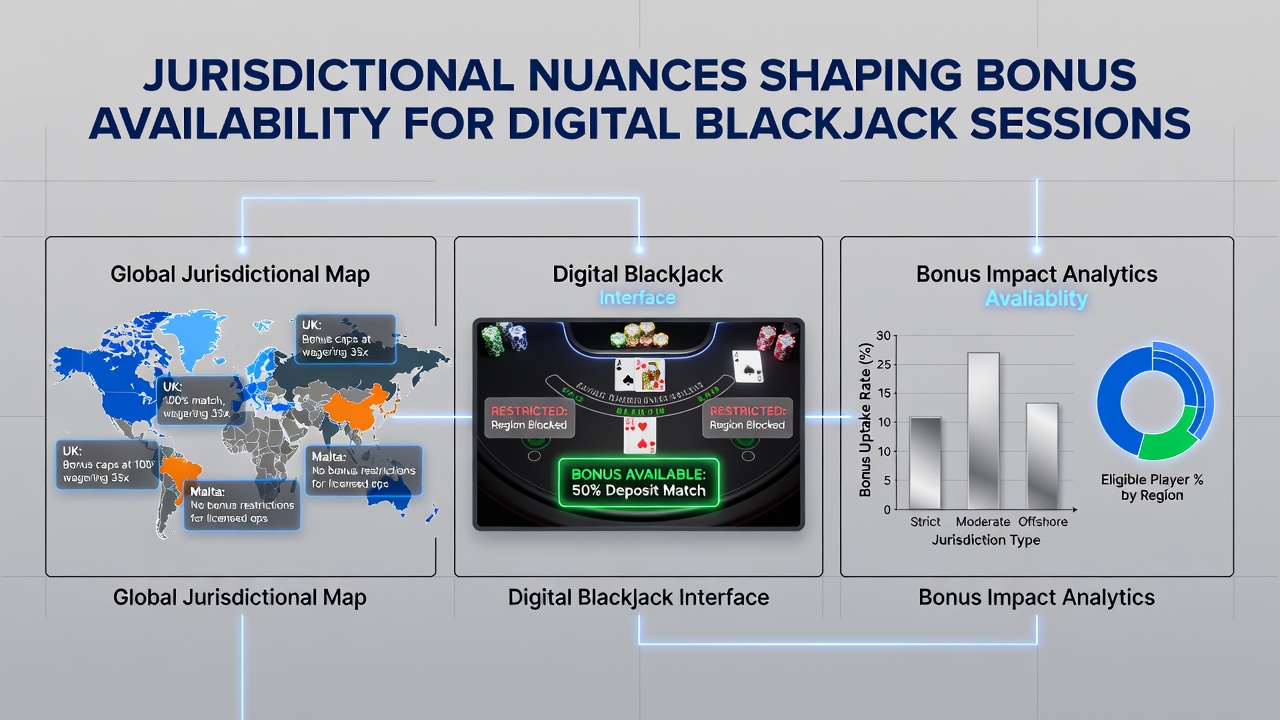
Operators licensed under the Isle of Man Gambling Supervision Commission maintain broader latitude for time-limited blackjack incentives, yet they must still align marketing language with each target market's language requirements. Research from the European Gaming and Betting Association indicates that cross-border bonus portability declined by 12 percent between 2024 and 2026 as more member states introduced mandatory pre-approval processes for table-game promotions.
Asia-Pacific Market Structures
Australia's Northern Territory licensing regime permits operators to issue blackjack-specific reload bonuses without prior sign-off provided total promotional value stays below AUD 500 per player per month, whereas New South Wales imposes a 48-hour cooling-off period between bonus claims. These thresholds create staggered availability patterns for players using platforms with multiple regional skins. In Singapore, the Remote Gambling Act restricts bonus offers exclusively to operators holding local licenses, effectively eliminating most international blackjack promotions for residents.
Japan's emerging regulated market, which began phased rollout in 2025, requires operators to demonstrate that blackjack bonuses do not encourage extended session lengths, leading to automatic time-out features embedded in promotional code systems. Figures released by the Japan Casino Regulatory Commission in August 2026 recorded that only 18 percent of licensed platforms offered blackjack bonuses meeting the new duration safeguards.
Compliance Overlaps and Player Impact
Operators holding multiple licenses must reconcile conflicting rules when a single platform serves users from several jurisdictions. A bonus code valid for New Jersey residents may carry a 25-times playthrough requirement, while the identical code for Ontario players triggers a 40-times threshold because each regulator applies its own risk-weighting formula to table games. Payment method restrictions compound these differences, since some jurisdictions prohibit bonus funding via certain e-wallets while others allow them without restriction.
Those who study licensing databases find that operators increasingly segment their bonus libraries by player IP address and verified address, ensuring that only jurisdiction-compliant offers appear during digital blackjack sessions. This segmentation reduces accidental violations yet also narrows the visible range of promotions for any given user.
Conclusion
Jurisdictional licensing frameworks continue to evolve, and the resulting variations in bonus availability for digital blackjack remain tied to the specific ruleset of each authorizing body. Players encounter different wagering multipliers, claim windows, and eligible game lists depending on the operator's primary license and the user's verified location. Regulatory filings through August 2026 confirm that these distinctions show no sign of convergence, leaving operators to manage parallel compliance tracks for each market they serve.